Honey Lemon Chicken

You know what’s fabulous? Chinese food.

The sheer size of China allows for a breathtaking amount of culinary diversity, from hot and spicy to sweet and delicate. Since we had a big family, we often had to go somewhere that would accommodate a large crowd, and the local Chinese restaurants filled that bill admirably. When I was a kid, I would look at the intricate mooncakes and family style dishes with badly suppressed curiosity.

You just could get so many things! You could order three or four dishes, and they were all something new with flavors I didn’t see at home (I inherited my adventuresome palate from my mom, really. She had a wok and a dream, but the eighties weren’t a great decade for spices in rural Oregon!) But the Chinese restaurants? Absolutely had our backs. Not only that, they had tea in little cups and, I mean, I was a kid, but being out with the family with pretty tea sets and a shared meal felt so delightfully fancy that to this day I gravitate to Chinese restaurants when I feel like a special meal.

Of course, now, most of the menu is off limits to me. Eggs feature in a lot of the dishes, many of the sauces, etc. use cornstarch or actual corn, there’s malt and/or barley in some of the vinegars, and it all uses soy (which I can maybe have once a month and then walk around looking sunburned), and then there’s the surprise peanuts lurking in the garnishes… What used to be fun is now a rather stressful experience requiring a lot of prep work and kitchen communication. So, when I want something to remind me of good times and family outings, I make my own approximation of a Chinese take out!

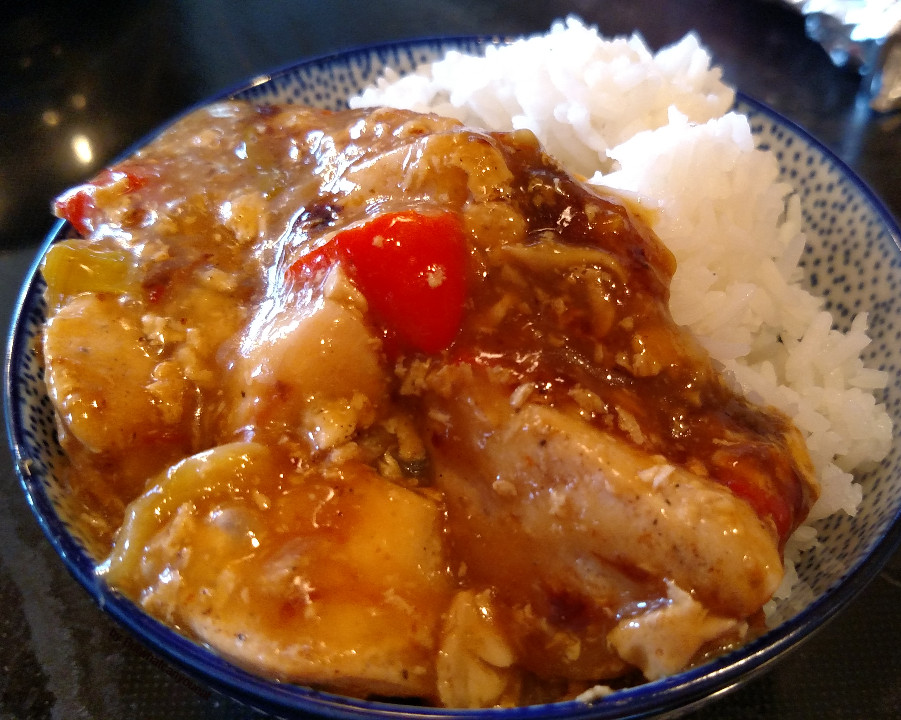
As you might have noticed, I’m a big fan of chicken and the way it tastes. I also love lemons. The recipe I have today is loosely based on the Orange Chicken recipe from The Woks of Life, a family-run food blog you’ve probably already heard of! And when I say ‘loosely’ I mean ‘exceptionally loosely.’ A ‘glancing acquaintance.’ The ‘We were at school together’ of a common effort at recipe making, because those guys have their culinary act together and I’m just coming up with stuff I like to eat that will please the family and won’t kill me. Or them, really.

So instead of cornstarch, we have tapioca. Instead of breading, I grilled the chicken, and instead of oranges, I used lemon juice. I haven’t been able to find a sesame oil I can use, so I just went with olive oil, and then I reconfigured the spices to meld with what I had on hand, and added some red peppers because I thought they bulked up the meal.

I liked the tangy sauce that resulted, and the way the honey gave the dish a more caramelized flavor. I liked how the spices warmed my stomach and the chicken was tender and juicy (which is difficult when all you have is the chicken breasts you found lodged in the freezer!)

You’ll Need (Serves 2 – 4):

To prepare the chicken:

2 – 4 chicken breasts or thighs, sliced into chunks

1/2 tsp. olive oil

2 tsps. Mirin (I can’t find a Shaoxing wine that works)

1/4 tsp cinnamon

2 cloves crushed garlic

1/4 chopped onions, or 2 tsps. onion powder

Salt and Pepper to taste (I used black pepper, because again, no white pepper yet)

Instructions: Chop up the chicken, and then put it, along with the spices, vegetables, and oils, into a ziplock bag and let it marinate in the fridge for at least 30 minutes to an hour depending on how much chicken you’re using.

For the sauce:

Juice of one whole lemon

1-2 tsps. fish sauce (this and mirin is my substitute for soy)

1/4 cup chicken stock

1-2 tsps. honey

1 tsp. red chili flakes

1 tsp. tapioca starch

Salt and Pepper to taste

Optional:

1 green onion, chopped

1/2 red pepper, chopped

1 – 2 heads of bok choy, chopped

To Make:

Put all the ingredients of your sauce into a bowl and stir in the tapioca starch with a fork. That way you can avoid little bumps of unwanted powder.

Heat a frying pan or wok with some olive oil on medium heat, and add your marinated chicken. Cook the chicken, turning once, until the bottom of the pan begins to develop a crust, and then add your vegetables. After the vegetables begin to soften, but not crisp, add in your sauce and stir gently to cover the meal. Cook everything together until the sauce easily coats the back of your spoon or spatula, and it’s nice and bubbling.

I like to have it with rice and a nice serving of garlic spinach or asparagus. The sharpness of the lemon pairs well with the melting sweetness of the honey, and the dish perks up my rather dreary not-quite-spring week. While it’s nowhere near the skill level of those Chinese restaurants in my memory, I feel like this is a good way to reincorporate the flavors I miss from when I was young. And, hey, if you can go and eat at your local Chinese restaurant today, do it for me, okay? I’ll live vicariously through you!
Orange Mango Ginger Smoothie

I like smoothies. They tide me over as a snack when I’m not feeling hungry enough for lunch, but my blood sugar is tanking, and they’re a nice way to get a bunch of fruit in my diet. Unfortunately, when you have as many allergies as I do, the actual making of said treat can be a little work.

For instance, I can’t have a lot of commercially made juices, whether it’s because of their added vitamins and minerals, or however they process the juice to begin with. So, I’m often stuck making my own, which…arm exercises aside, can be a pain. So, if you’re wondering, the answer is yes, to make one smoothie, I juiced 7 tiny oranges in order to use them up before they went bad. It came out to be about 1 1/3 cup of orange juice and while it was, admittedly, delicious, if you can drink orange juice from a jar? Absolutely go for it! There is no shame in allergy eating, there’s only what you can eat, and what you can’t.

You’ll need (make 1 smoothie):

7 tiny mandarin oranges slowly gaining sentience on your counter

1 handful of mango

1 tsp ground flax seed

1 tsp leftover coconut pulp (optional)

2 Tbsp. cashew yogurt

Ground or minced ginger, to taste

1/2 tsp. honey

1 handful of ice

First off, juice your oranges. I used an ancient tupperware attachment that formerlu belonged to a pitcher (now lost to time) and a bowl, cut the oranges in half, and then just wrung them dry in the cereal bowl. I also then counted it as my exercise for the day, but remember there’s no judging! Anyway, I poured that into a liquid measuring cup every time the bowl got unwieldy. I had some chopped up mango leftover, and tossed that in the blender, before adding in the flax seed, ginger, yogurt, honey, coconut, and ice.

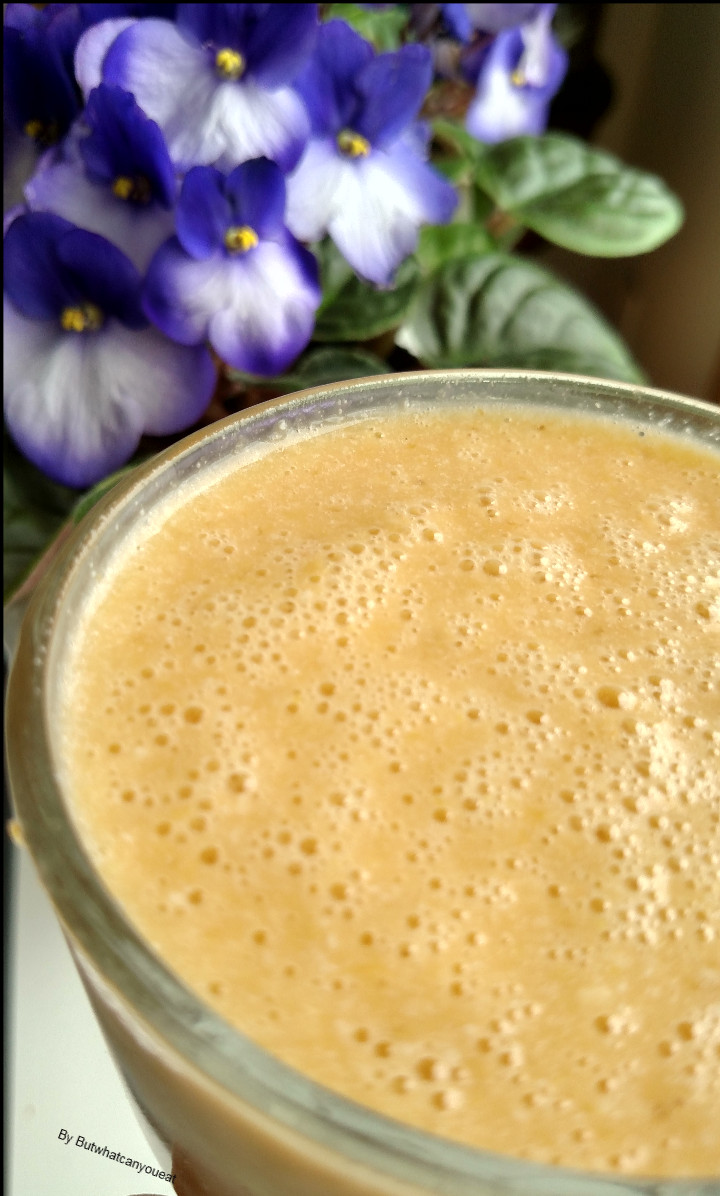
Then, using the orange juice instead of my usual water, I blitzed the entire thing in a blender, and poured it out into a cup. It tasted like summer in a glass, tart and not too heavy, with an underlying sweetness that I didn’t find too cloying. I always like to include ice in my drinks because…well, it may be raining like the dickens for three weeks straight here, but I still love cold drinks. I’m very basic, I know.

This made my grey day a little more bright, and I hope it does for your grey days as well!

Lemon Paprika Chicken

The thing I like about chicken (Besides the fact that blood tests show I am very, very deeply not allergic to it) is its versatility. You can make a chicken in such a variety of ways and to so many tastes and budgets that it becomes the star of any meal.

An entire chicken is an expense–especially these days–but it’s also extremely good value for money. It feeds an entire family for a number of days, and the bones make broth to extend that deliciousness even further. My mother used to make a chicken for work for her (as she says) for at least a week and beyond, and I say good for her!

This is a recipe I make a lot for my family, using spices and herbs I’ve tasted before and can safely consume (the less said about the Smoked Paprika Debacle of 2019 the better!) so I hope you enjoy as it as much as I do.

You’ll Need (serves 4 – 8 people):

1 whole chicken, giblets removed

1 Tbsp. salt

1 Tbsp. black pepper

1 lemon, peeled and halved

3 tsp. paprika

2-3 cloves of garlic

1/2 onion

Olive Oil

1 large baking dish

Preheat your oven to 375F.

Get out a large baking dish and cover the inside with aluminum foil. Pour in a 1/2 tsp. of olive oil.

Take your whole chicken out of its wrapper or bag, and give it a good swipe with some water, and then pat it dry with some paper towels. If you want to make the skin a little more tight, or it’s got some feather remnants, rub the skin with a little salt and then clean it off again (or else the chicken will be too salty!) Now, check inside the chicken for that little bag of giblets. If it’s there, pull it out and set it aside on a napkin.

Place your chicken breast-sides up in the baking dish, and tuck the points of its wings under the body to help prevent burning. If you can’t, don’t worry about it, but it does make cooking a little easier.

Wash your hands! (Always wash your hands multiple times when dealing with chickens. It’s just good food safety practice!)

Peel your lemon, tear it in half, and then put the lemon, the garlic cloves, and the onion up inside the chicken. This will make dinner very flavorful, and imbue the meat from within.

Now, cover the outside of the chicken with the salt, pepper, and paprika. Then, go over the entire top of the chicken with a medium-thick layer of olive oil. Picture about 1/3 of a cup or so.

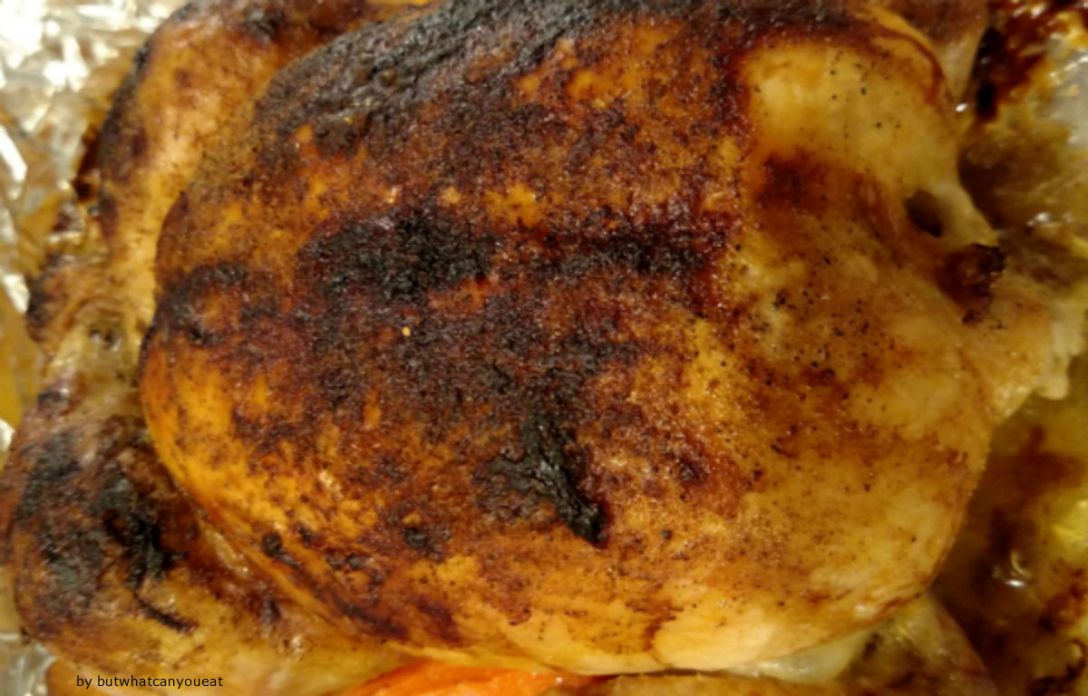
At this point, if you want, you can slice up some carrots and celery and place them around the chicken. They’ll cook together and make an excellent side dish! I do that often, as you can see from the picture, but I prefer to roast my potatoes in another dish, because I don’t like the texture when they cook alongside the chicken.

Place your baking dish full of chicken into the oven and cook from 1 1/2 to 2 hours at 350F. You’ll know the chicken is cooked when you poke the skin with a fork and the juices run clear. If you have any concerns, shove it back into the oven for fifteen minutes and then check it again. There are no heroes in undercooked chicken! There are only trips to the doctor’s office.

After enough time has passed, take the chicken out of the oven, and set it on a trivet to cool, and let it rest for about 5 minutes. I don’t know why, but letting meat rest out of the oven is supposed to allow it to relax and retain more of the juices still inside the meat. Cut the meat from the bones, and serve with hasselback potatoes or roasted sweet potato bites, and a good helping of peas!

Additional Comments:

If you don’t have a lemon, substitute Lemon Thyme, which gives the chicken a really nice, light flavor

If your supermarket’s butcher cuts up chicken for free, you could do this recipe with half a chicken, or two quarter pieces. Just adjust the cooking time to about an hour, and check on it often

Throw out the oily herbs and vegetables, etc. you cooked with, but pour the cooking liquid left over in the pan into a bowl. You can stick it in the fridge, and then add it to the stock pot when you make broth later!

Vegan Pesto Pasta: The Oregonian Treat

All right, that isn’t a thing, and no one other than me probably remembers that Rice-A-Roni jingle, but the title made me laugh, so I’m using it. Ha!

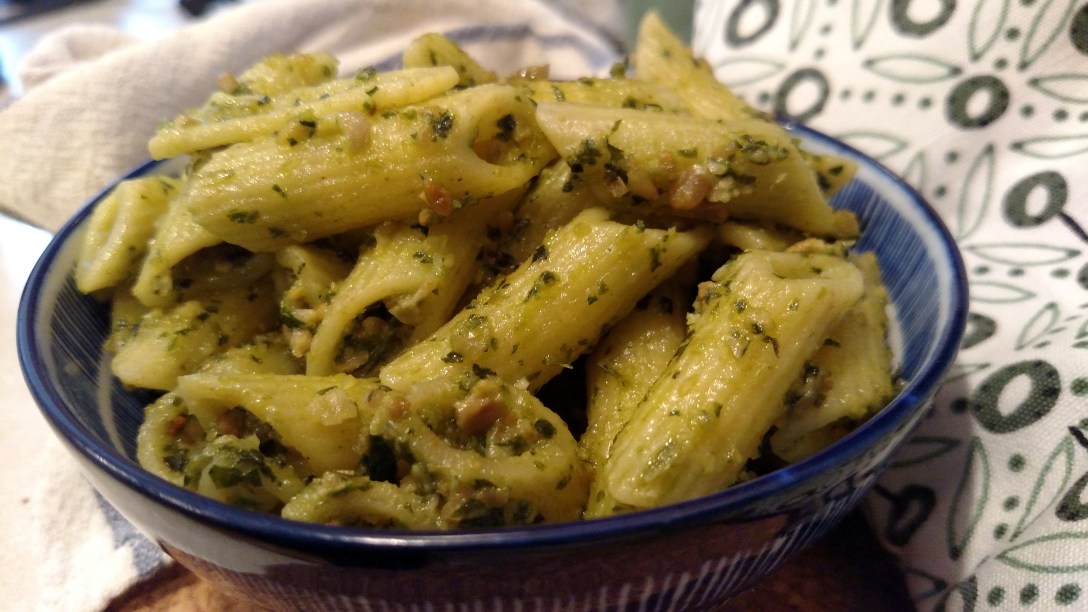
I’m told traditional pesto has a great deal of cheese in it, and reading the labels of the little jars in the supermarket certainly bears that out. I’ll be honest, I bet it’s fabulous (my mother certainly agrees!) but since I can’t have it, I decided to come up with a version that would taste good to me and my family members whose bodies work properly. It’s been taste-tested numerous times as a quick, easy meal for a weekend lunch or dinner, when all anyone really wants to do is poke someone else until they’ll do the cooking. Got 10 minutes? You got a meal!

You’ll Need (serves 6):

1 bag of fresh spinach, washed and dried

1 big handful of fresh basil leave, washed and dried, or 2 Tbsps. dried basil

1/2 cup sunflower seeds, roasted in their own oil

1-2 large cloves of garlic

Juice from 1/2 of a lemon, or about 2 Tbsps.

Salt and Pepper to taste

Olive Oil (I tend to use 1/3 – 1/2 cup)

Put all the ingredients, except for the oil, into a food processor or blender, and turn the machine on to high. While it’s running, pour in olive oil. If the mixture begins to stick high up the sides, stop the machine, and push down the concoction so the blades can reach it. Turn it back onto high and keep adding olive oil until the whole thing looking like a sauce. Mine didn’t take more than five minutes (and quite possibly less!)

Turn off the machine and taste test it. Is it too sharp? Add more spinach. Does it need more salt? Add some. Sauces are really things that you have to make to your specific taste. I can’t add nutritional yeast to this, as people often do, because I get different answers to my allergy questions from within the same companies. That’s why I add lemon juice for brightness, but if you can eat nutritional yeast, then feel free to add a teaspoon or two for your own pleasure. Tell me how it tastes, I’ve always been curious!

To serve this, I made gluten free pasta. I drained it, and let the hot noodles cook the sauce a little to draw out the flavors. I didn’t reserve any of the pasta liquid, but if you’re eating traditional pasta, then you should absolute keep back a half a cup or so to meld the sauce with the starches.

I like this recipe. It’s got a wonderfully basil overtone, and I think the spinach gives it heft and body. The lemon and garlic give it an entirely unctuous quality, which I know sounds silly, but that’s how it tasted to me. Sometimes I’ll add shrimp if I’m quite hungry, but usually I just eat it plant-based, just as is. It’s lovely hot, or cold the next day.

Additional Comments:

Just to remind you, if you use bagged spinach, there’s a likelihood that you might accidentally have cross-contamination with a corn-based cleaning wash that they use on the loose leaves. If possible, try to get spinach that’s unbagged or from a brand you’ve used before and not reacted to. I also always thoroughly wash my vegetables, regardless if they say they’ve been pre-washed or not. I know it’s a hassle, but I always want people to be as safe as possible. If you have a very sensitive allergy, then this might not help you, but it works for me!

Citrus fruits can often have corn-based wax on their peels in order to lock in their freshness. I’m doing okay just peeling them and only having the juice or pulp. I never use lemon peel.

Hasselback Potatoes: When You Want Fries, but Cutting Them Up Seems Hard

Sometimes I want fried potatoes, but a) can’t because deep frying terrifies me, and b) my lord, does it seem like a lot of work. When in doubt, and when I want to look fancy, but also feel a bit accomplished, I make “Hasselback Potatoes” which are a sort of crossover potato dish. They’re fancier than just plain ol’ baked potatoes, and the slices mean I can stuff just…so much more fake butter and salt than I should. And you can put anything you want on it! Make it vegan and plant-based! Make it paleo or vegetarian with all the cheese in the world. Add bacon and get your carnivore on! It’s your potato! So come with me, theoretical reader, as I show you have to make the one potato dish you’ll ever need for when company calls, or you want to treat yourself to a date for one.

Let me just get out here that I have no idea where this dish came from. Wikipedia has an unsourced accreditation to a Swedish chef (insert muppet here) in 1959, but I only remember hearing about it a couple of years ago…possibly on the Food Network. Regardless of however it came into my life, it is a potato dish, and thus, I will never let it go. I confess I hate the texture of baked potatoes, and love the brazen salt glut of a good pile of fries, and Hasselback potatoes hit me in the happy medium. Also, I made ketchup again, and I needed something to drench in it. (Pity me, it’s a disease!)

For people like me, with a corn allergy, root vegetables like potatoes can be dangerous. They soak up a lot of what’s in the ground, and so if the farmer grows them in the field with corn-based fertilizers or sprays them with corn-based chemicals for shipment, you can run into real trouble. When I buy potatoes in the grocery store, I buy loose potatoes–not bagged–and I try to aim for the dirtiest ones I can find.

I know it sounds weird, but it’s true! The more dirt is on a vegetable, the less likely you are to run into some kind of chemical you might be allergic to, like the sprout inhibitor some potatoes are sprayed with. Always be careful!

You’ll Need (Serves 1):

1 medium sized potato (I like russets or yukon golds)

1/4 cup olive oil

Salt and Pepper to taste

Preheat the oven to 375F, and line a casserole pan with aluminum foil. Then wash and peel your potato, removing any dark spots or hardened eyes you uncover.

To make Hasselback potatoes, take a sharp, heavy knife, and carefully cut slices width-wise down the length of your potato. You want to make each slice approximately as big as teh other for each cooking, and you want to take the knife down almost but not quite cutting through the potato. Be very careful with your knife! I speak as one who has sawed through their thumbnail and lived to regret it.

Decrease the oven to 350F. Put the potato in the casserole dish and cover in oil, salt, and pepper. Cook until a fork can be pushed into the side of the potato easily and come out cleanly (about 45 minutes to an hour). Then add whatever toppings you want! I like salt, pepper, a lot of Miyoko’s fake butter, and a dollop of Forager’s unsweetened plain yogurt.

Building Block: Cashew Milk!

I never thought I would be the sort of person to make my own alternative milk (I tried, but I’m secretly twelve and saying ‘nut milk’ makes me giggle), but here we are! Like a lot of people with multiple food allergies, certain staples are beyond me not because of their base ingredients, but due to their additives.

Milk made from almonds, or cashews, or any kind of ingredient like that usually contains vitamins and thickeners to help disguise their original texture and make it ‘feel’ more like milk when we drink it. The problem for me lies in the carrier oils that get that vitamin E into the drink. I can’t say for certain, because most companies don’t dive so deeply into their ingredients lists to post the ingredients of their ingredients (if you get me. That was a clear overuse of the word ‘ingredients’)

So when I turn red and get a bit tender around the face, I have to go back to my old friend: Square One and restrict my diet to see if I’ve added something new to my diet that my body doesn’t like or…the company has changed its recipe (dunh dunh Dunh!) After you do this a couple or ten times, the novelty has a way of wearing off.

Which is why I began making my own alternative milk on my own. In my own house! I feel like a Tudor housewife in far more comfortable clothing. However, with a corn allergy, I should note that you need to be careful where you source your nuts. If you have a more severe allergy, you might get bit by how the nuts are harvested/processes, and even the packaging.

To combat this, I went with a brand I’ve eaten before, and which I more or less trust in terms of packaging consistency. I also always rinse my nuts before I start turning them into milk. I don’t know if that helps, but it certainly can’t hurt, and it makes me feel better. The one thing I’ve learned while Eating Allergic is that I need to take the steps that make me feel more secure. If I don’t, who will?

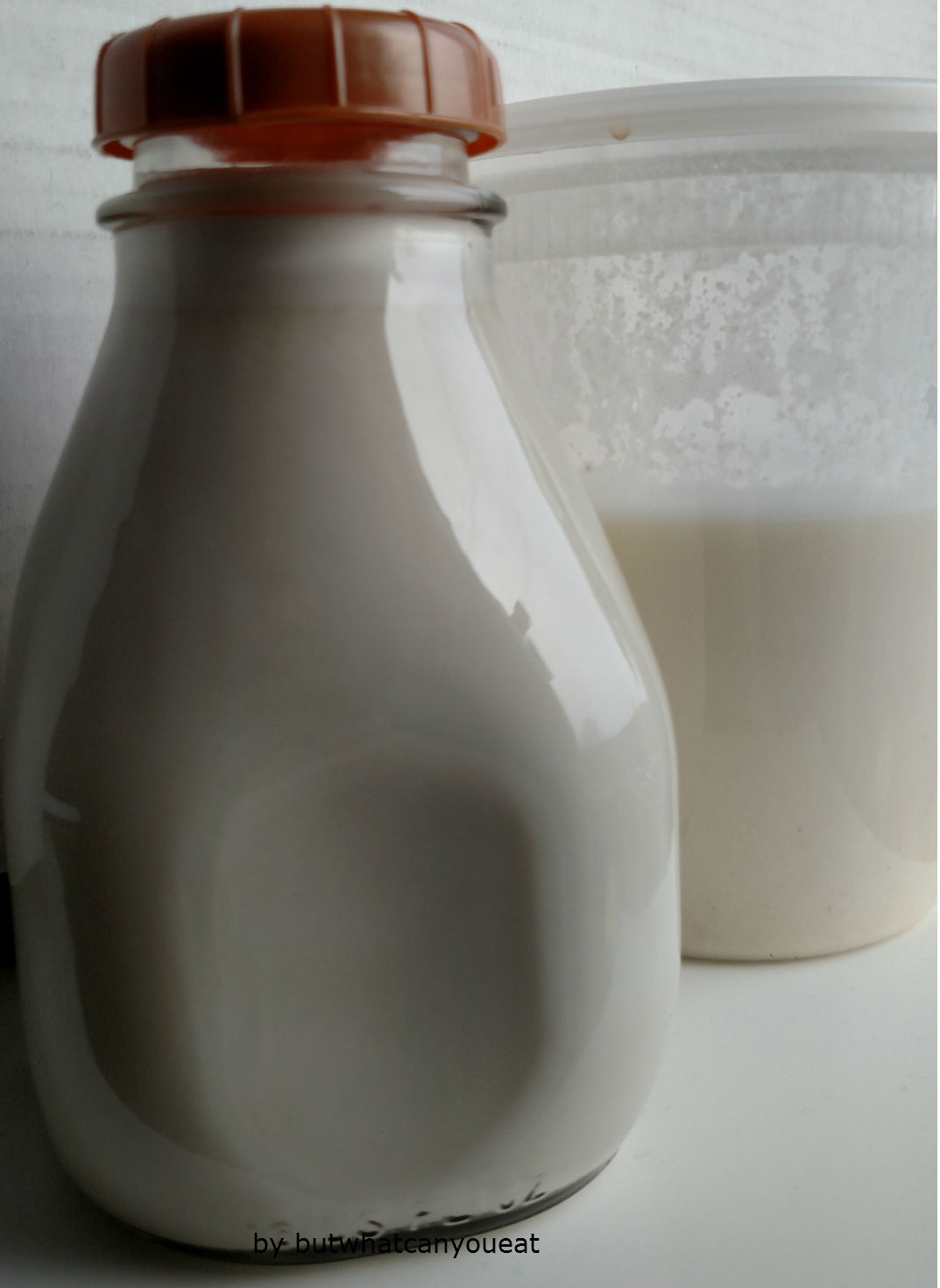
This is cashew milk, which has a mild, delightfully luxurious density and flavor. I like it better than almond milk (too bitter) and I think the texture is leagues above too-watery rice milk. I use it in my coffee in the morning, and for baking.

You’ll Need (Makes 4 cups):

1 cup raw cashews

2 cups cold water (to soak)

1 tsp Honey (or to taste)

½ tsp kosher salt (or to taste)

4 cups cold water (to blend)

Rinse 1 cup of raw cashews, and then put them in a bowl with 2 cups of cold water to soak either for at least 6 hours, or overnight. I prefer overnight, but you do you!

In the morning, drain the water from the cashews, and blend together ½ cup of the cashews with the honey and 1 cup of the water until the nuts are completely blitzed. Pour into a separate bowl or jug with a lid, and repeat the blending with the next ½ cup of cashews and another cup of cold water.

Add the last cup of blitzed cashews into your bowl or jug, and then mix in the last two cups of water. I think this has the texture of a higher fat milk, but I honestly don’t remember what milk tastes like, so your mileage may vary. You can make the milk lighter or thicker depending on the amount of water you use in the recipe. This amount lasts me about a week, or week and a half, and I find it easily scalable for when I need more milk in a recipe.

Additional Comments:

  • I don’t sieve my milk, because I don’t mind the particles leftover from blending, but if you do, then I recommend putting it through a drip coffee filter (let gravity do the work!) or buying some cheesecloth and pouring the blended nuts and water through the cloth prior to adding the last two cups of water, and then squeezing very gently and carefully.
  • You can also definitely use those blitzed particles in a different recipe! Spread it carefully on parchment paper on a tray with a lid. Dry it out in an oven at about 250F and it can be added to GF flours while baking, or used as part of a brittle, and even a pie crust! Just be careful about the amount of liquid
  • I believe you can use this recipe for any kind of raw nut with which you want to try making into an alternative milk, or white rice (I don’t know about brown). Just make sure the nuts are raw!

Coconut Cream Chocolate Cake

You ever need a dessert that doesn’t take a lot of time and comes out looking presentable for company? I don’t often have that need, but I’m eating Christmas at someone else’s home this year, and one of the ways I like to contribute (and ensure that there’s a dessert I can eat!) is to volunteer myself to bring a cake, or some cookies, or a couple of sides, a chicken, and the left hand side of the menu.

Look, I get nervous when I eat out, okay? Two weeks ago, I had half a sandwich at Panera and wound up with a tight throat, three days’ worth of hives, and a depleted Benadryl stash. This is through no fault of the company of course! I had told the servers I have food allergies. This is just the risk I run when I eat outside my own kitchen, even when I’m eating foods I haven’t reacted poorly to before.

So to make myself feel better, and to help me gear up for the holiday cooking marathon, I decided to make a cake. A chocolate cake to be precise, using gluten free flours, and more cocoa powder than is probably good for me. It also let me test out an idea I had for a cake without all the fake butter, which I didn’t have in the fridge, and nut milk…which I had forgotten the night before.

But what makes a cake? The reason we use butter and milk is because we need liquid and fat to create something more unctuous than sugar and flour can provide; it’s the difference between cake and enriched bread. So I vaguely remembered a friend passing me a cake recipe without eggs, butter, or milk that only needed coconut cream (I have looked and looked, but I cannot find the recipe! So thank you, anonymous cake maker, and if I ever find that link again I will be including it here).  I needed to make one big enough to share, but not overwhelming and—since I had the idea that all that coconut would make it way to rich, be able to stand on its own without frosting.

Most cakes, especially gluten-free and plant-based cakes, are just as delicious as fully dairy, egg, and sugar cakes are. Unfortunately, none of those are guaranteed to be allergy-friendly, much less allergy-free!  Like many people, I can’t have baking powder or eggs, vanilla extract, or xanthan gum. But I can have coconut, and that’s all the delightfully fatty goodness I need to make a cake.

The result is a chocolatey delight, rich enough to satisfy anyone’s dessert cravings. It’s quite dense and rich because of the coconut cream, but I didn’t taste any coconut when I tried a piece. Or the morning after, when I tested it again. Or the day after that. Look, I ate a lot of it, and had no complaints.  I made three 5″ cakes, and popped one in the freezer (that’s what I do with practically everything) and it defrosted well. To make it fancy, I shook some powdered sugar over the top, but I think it holds up well on its own. Maybe next time I’ll add an edible flower or two?

You’ll Need (serves 6-10):

1 1/2 cups white sugar

1 13oz. can coconut cream, shaken well and at room temperature

½ tsp. baking soda

1 tsp. salt

1 Tbsp. cold water

4 flax eggs

1 cup cocoa powder

1/3 brown rice powder

1/3 millet flour

1/3 sorghum flour

1/2 cup arrowroot flour

Preheat your over to 375F. 

Make your flax eggs fifteen minutes before starting your cake, and then mix all the ingredients except the flours and baking soda together. In a different bowl, stir the flours and the baking soda together, and then slowly add it into the wet mixture. Stir the cake together until there are no lumps and make sure you’re incorporating some air (try counting to 360 while stirring, if you’re doing it by hand).

Grease two 8”-9” pans, or three 5’ pans (like I did). Pour the cake batter up to a little over the halfway mark in each pan, and let them rest for about twenty to thirty minutes.

Decrease the temperature in the oven to 350F, and put your cake pans in!  Cook for about 30-40 minutes, or until a fork stuck in the middle of the cakes comes out cleanly.

Cool the cake in the pan for ten minutes, before turning the pan upside down on a cooling rack and letting it complete cool.

Additional Reminders:

  • Don’t be alarmed if your coconut cream had tiny white chucks floating in it! Those are okay.  If you open the can and the coconut cream is too hard to mix, spoon it into a microwave safe bowl and warm it up in the microwave for fifteen seconds.
  • If you’re making this cake with regular AP flour, then you don’t need to let the batter rest, and you can take out the eggs entirely. The flax eggs in the gluten free recipe are to provide structure for the GF flours.
  • If you’re in a rush, turn this into cupcakes! They’ll cook faster, and they’re more portable. After about twenty minutes, stick a fork in the center cupcake to test the doneness.

Building Block: Homemade Tomato Ketchup

If you have an allergy, shopping at the supermarket can be a little more fraught with pitfalls than your average consumer, and you can’t always escape that desperate scroll through a laundry list of ingredients by going to a farmer’s market or signing on for a CSA. A lot can depend on how a food item is stored or processed, what it’s been sprayed with, and even what field the food is near (I’m looking at you, raw honey!). In short, finding food that’s safe for you and your family when there’s a food allergy in play can be a lot of ‘trial’ as well as the horrible frustration of a whole lot of ‘error.’

How this works out for me, is that there are many store-made foods I just can’t have, even when the ingredients list works in my favor. Soup stock, alternative milks, and many condiments are on this list, and even though I’m still trying to find some of these items, there is simply no guarantee that I’ll succeed.

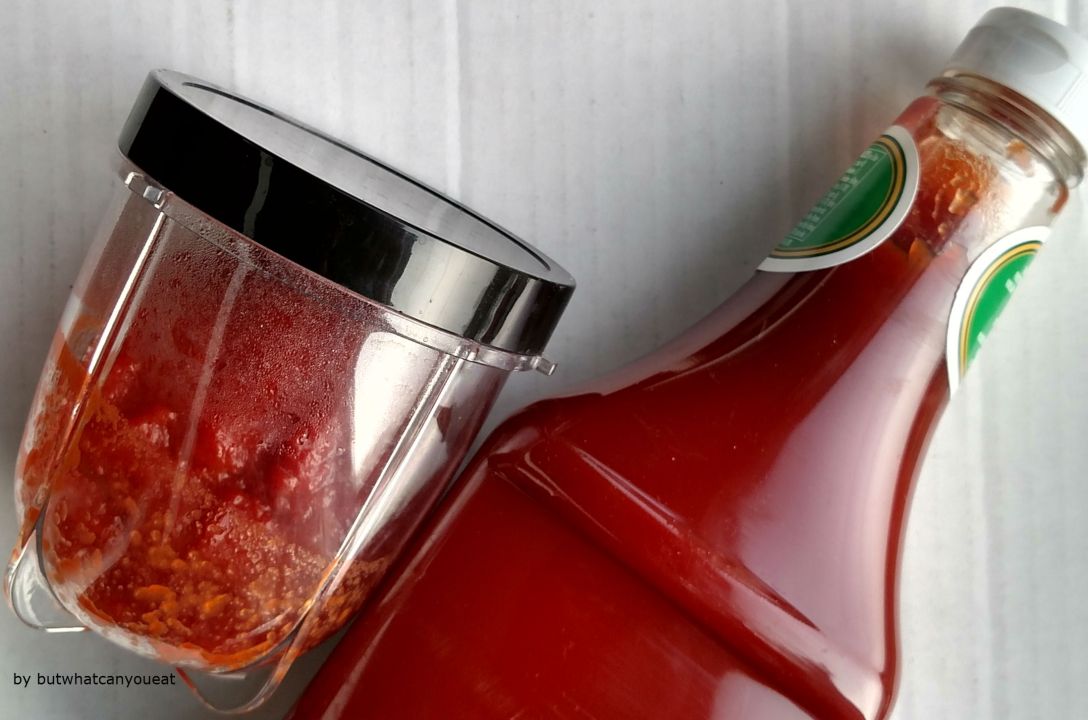
Thus, I have brought to you today….a recipe for ketchup! No, I know! Actual ketchup! It’s a thing you can make!  I was also surprised. There are just some foods that you don’t think about cooking up until fate or craving sort of forces you into scouring your bookshelf for incredibly old recipes.

Many of those recipes resembled something more like the Brown Sauce you find in the UK, or like a thickened version of Worcestershire Sauce which wasn’t what I wanted at all. In my head, ketchup is a tomato-based delight, slightly sweet, but with an underlying tart saltiness and a smooth thickened texture. I wanted a sauce I could drag a fry through and have it come out clinging to the potato rather than drip off the side, if you know what I mean.

Finally, I settled on an approximation of all the recipes I had seen, only drastically reduced because if I failed at this recipe, I didn’t want to be saddled with cup after cup of some nasty tasting marinara. So I made some substitutions, did some highly suspect math, and complained endlessly to my friends via text that I was going to burn my ketchup like some city slicker who just arrived on the prairie. I could sense the ghosts of my ancestors rising up to judge me (my grandmother, in particular, just wanted me to keep trying with store-bought.)

Short story, I did not burn anything! (I did take about a ½ inch of skin off my ring finger, but that’s an unrelated incident). And the result was…ketchup! Actual, real-tasting, tried and true tomato ketchup! I felt so accomplished, I can’t even tell you.

But it also impressed upon me how much time and investment making ketchup is. A little over two pounds of tomatoes produced ½ cup of actual ketchup. All the recipes I found called for immense amounts of ingredients, at a cost today which most people (including me) might honestly find prohibitive, not just in money, but in time spent cooking. That’s the trade off with a lot of allergy-friendly products: what others can just pluck off the shelf, we have to devote time and thought and money to achieving.

So this is my admittedly delicious, but scaled down recipe for tomato ketchup. It’s easily adjusted to create more, but I honestly recommend creating a small batch of the stuff—as I did—to make sure you like the flavor and want to devote the time to making the product. I think making this recipe greatly increased my confidence in the kitchen (I made a condiment! Me!). It feels really good to know that I can still have something, even if all the store-bought varieties so far make me itch.

You’ll Need (serves 1):

~2 lbs. tomatoes

water, for boiling

¼ cup apple cider vinegar

1 large clove garlic

1 tsp. white sugar

¾ tsp. salt

1/8 tsp. nutmeg

¼ tsp. onion powder

1/8 tsp. paprika

Wash your tomatoes and add them to a large pot with a lid. Pour in enough water to cover the tomatoes, and then bring them to boil on the stove top. Once the tomatoes have split, remove from the stove and drain the water.

Using a fine mesh strainer and a spoon, or a berry press, press the juice and pulp out of the tomatoes back into the pot you just used. Make sure to scrape the bottom of the strainer to get all the good stuff!  Add in all the rest of the ingredients, and then reduce the sauce on low to medium-low for three hours, or until the sauce resembles ketchup. It should be thick enough to part with a spoon and it should definitely stick to the back of said utensil. Stir frequently to make sure that the sugars don’t burn. Allow it to cool completely before putting it into the refrigerator.

Additional Comment:

Around 2 lbs. of tomatoes yielded ½ cup of ketchup.

If you’re scaling up this recipe, please remember that this is a heavily reduced condiment so all the flavors will be quite concentrated. Less is definitely more!  Also, if you’re worried about the amount of nutmeg, try substituting with mace instead.

Roasted Sweet Potato Bites

I love sweet potatoes, let’s just begin there. They’re sweet without being cloying, they’re delicious, and you can make them with a minimum of fuss which I deeply appreciate in a root vegetable. You scrub ‘em up, oil ‘em down, stab them a few times, then stick them in the oven until they pop out steamy and fluffy and delicious. Sweet potatoes: They’re great!

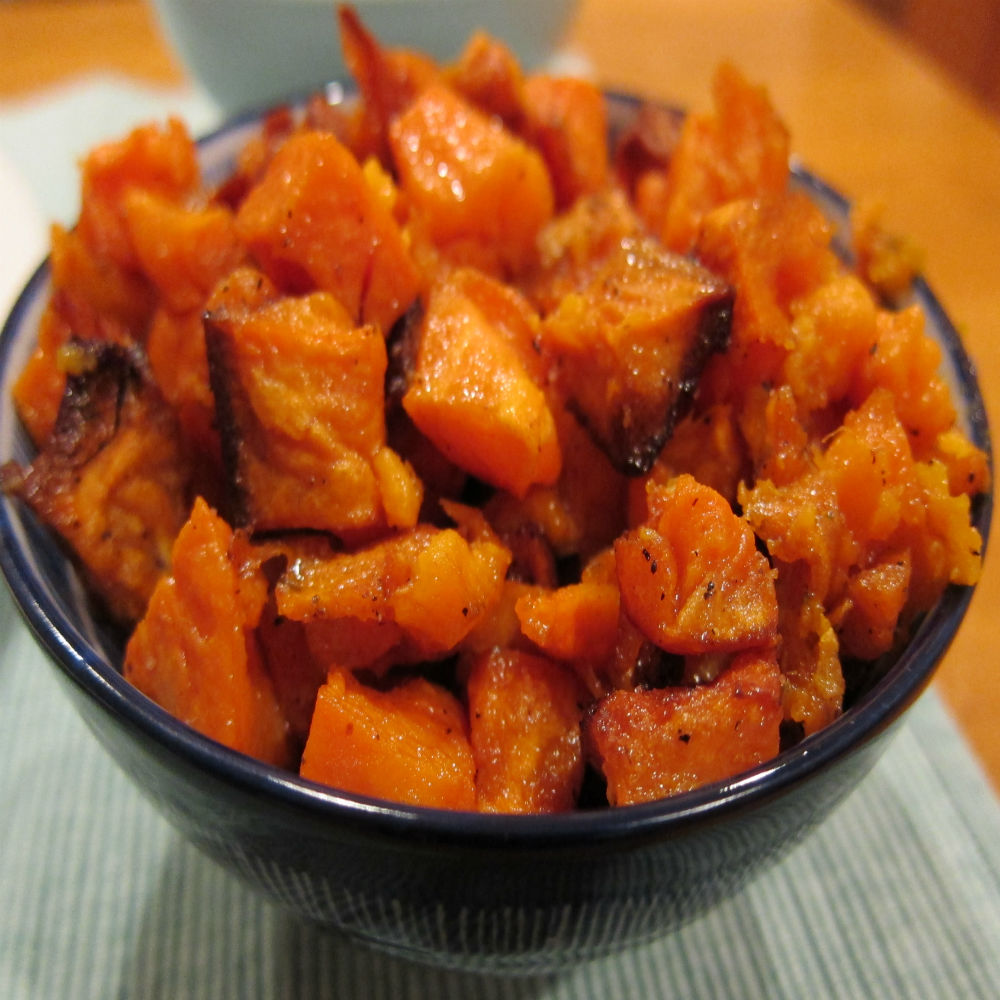
But sometimes I want to be fancy, like on Thanksgiving, and when I want to push the boat out a little I go to this recipe for diced, roasted sweet potatoes. They take a little work, but they come out sweet and tangy, and so entirely worth it.

Just remember, if you don’t have a food processor, it’s perfectly fine to cut the sweet potatoes into larger chucks. I find the safest method for me is to turn the potato over by a half or a quarter turn (depending on size) each time I make a cut while holding my knife firmly at an angle.

You’ll Need (serves 2 – 4):

2 – 4 sweet potatoes, cleaned, skinned and diced

1 – 2 tsp. ground ginger

1 – 2 tsp garlic

2 – 3 tsp. sugar

2 tsps. Rice vinegar

1/2 – 1/3 cup of oil

Salt and Pepper to taste

Preheat your oven to 375F

Clean your sweet potatoes with cold water, and then skin and dice them. Use either a food processor or a good sharp knife. Take a large bowl and put the ginger, garlic, sugar, rice vinegar, and oil, salt, and pepper into a large bowl.  Toss the sweet potatoes in the mixture and then pour it out onto either a large baking dish or a roasting sheet lined with aluminum foil.

Put the sweet potatoes in the oven, and decrease the temperature to 350F. Keep an eye on them in case the sugar starts to burn. They should cook, depending on size and amount, from forty minutes to an hour, but make sure to try and turn the potatoes at least once. Once they’re cooked through (you should be able to stick a fork easily in the largest piece) take them out, and spoon them into your serving dish.

Rice Stuffing For the Rest of Us: Gluten-free and Allergy-Friendly

In my family, the side dish you’re always going to see is rice. I can eat it, my mother can eat it, my little brother can eat more of it, but he is only smaller than me in years so that makes sense (seriously, it’s so difficult to be so much older and yet so much shorter!) Even when I could eat practically nothing without reacting to it, I could eat jasmine rice.

But on Thanksgiving—at least in my family—there was never a grain of rice to be seen. It just wasn’t a part of my grandmother’s traditional menu, and changing that line up required an Act of Congress and a two-thirds majority of Aunts. When I was younger, it wasn’t so much of a problem, but now that my food allergies outlaw so many commercial brands and ingredients, putting together a meal that both tastes good and reminds me of my childhood Thanksgivings takes a little bit more ingenuity. Enter Rice Stuffing!

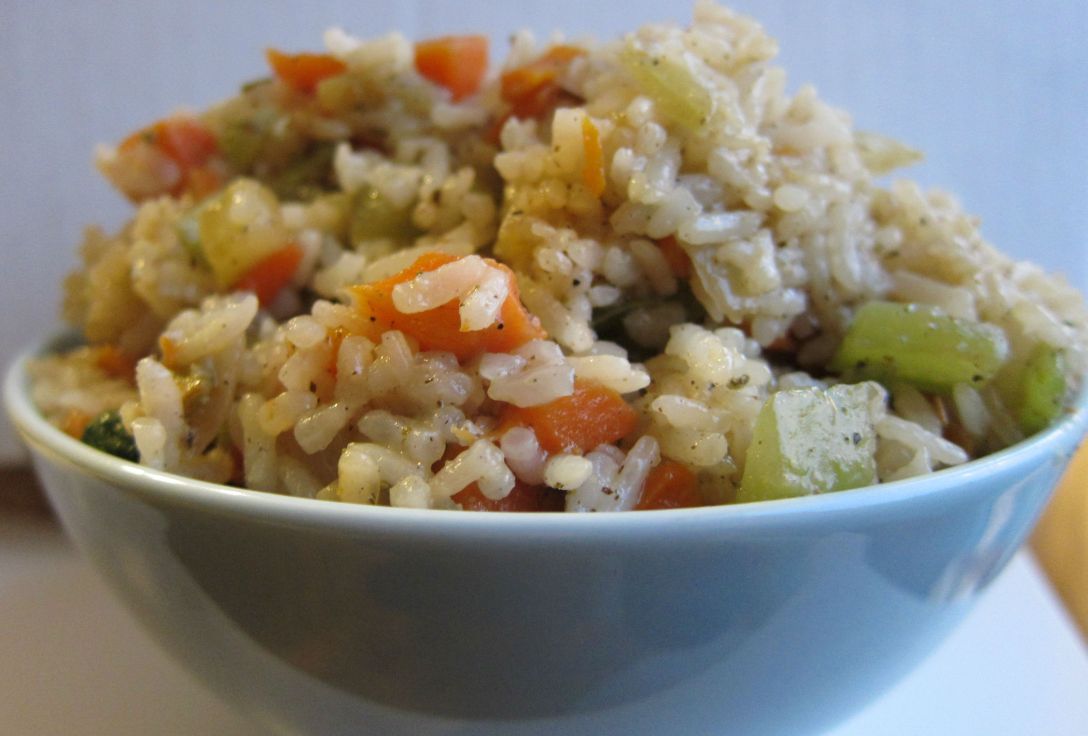
I knew two things I wanted when I set about putting this recipe together: I wanted it to taste like regular stuffing and I wanted the whole dish not to take forever and a day to cook. I think I’ve succeeded on both fronts with this recipe, which creates mound after mound of flavorful rice stuffing dotted with vegetables and herbs. It’s easily adaptable to whatever stuffing recipe you hold dear to your heart as well, and it’s absolutely no muss, no fuss.

You’ll Need (makes 6 servings):

2 cups cooked white jasmine rice

2 carrots, diced small

2 celery stalks, diced small

1 medium-sized onion, diced small

2 – 3 Tbsps. Olive oil

2 cloves roasted garlic, either smushed or chopped

2 tsps. salt

2 tsps. black pepper

1 tsp. red pepper flakes

2 tsps. thyme

2 tsps. sage

1 tsp. rosemary

2 tsps. parsley

1/2 – 2/3 cup broth (use mushroom broth to make it vegan!)

Optional:

1 cup crumbled sausage meat for a heartier dish (cooked with the vegetables)

1 cup button mushrooms, chopped (cooked with the vegetables)

Make the rice ahead of time. When you put the rice into the mix, it should be room temperature, but not cold. You’re also going to need a metal spatula to scrape the bottom of your pan.

Put your oil into a deep frying pan and heat the pan to medium. Dice up your vegetables and add them to the pan, making sure to also add in all the herbs and spices, except for your garlic.  Let that cook down, stirring occasionally, the vegetables soften and the onions become translucent. Add in your garlic and stir until you can smell it.

Push all your vegetables to the sides of the pan, and make a well. Add in your cooked rice, and break up any clumps with your spatula. You want the rice to warm through, so carefully stir it in with the vegetables. When the rice mixture begins to stick to the bottom of the frying pan, creating a sort of brown skin, slowly begin pouring in your broth. You want to add enough liquid that the rice plumps up a bit and comes away from the bottom of the pan, but not enough to drown the rice and make it a solid mushy mess.  Keep turning the stuffing in the pan until every grain of rice shines with the ‘sauce’ you’ve created and the food has begun to stick again. Then, transfer to a serving dish, and it’s ready to go!